
We empower small 1B and 2B parameter AI models to deliver the depth and intelligence of massive, cloud-scale models. By pairing lightweight edge LLMs with storage-backed binary knowledge repositories, our architecture shatters the inference wall on low-powered, embedded, and legacy hardware.
See How It WorksModern interactive AI agents rely on a dynamic compute-on-demand paradigm, forcing edge devices to generate every single response token-by-token at runtime. This creates an "Inference Wall," requiring heavy RAM budgets and causing rapid thermal drain.
Because of this barrier, manufacturers struggle to put smart, comprehensive AI into everyday electronics, wearables, IoT devices, or legacy servers without costly hardware overhauls.
At MMAP Labs, we bypass this bottleneck by externalizing high-density domain knowledge into storage-backed binary repositories. Our POSIX mmap virtual memory architecture enables a lightweight 1B or 2B model to instantly access massive pre-compiled knowledge blocks—delivering large-model capabilities without the massive hardware footprint.
Our patent-pending technology allows a compact 1B or 2B parameter model to perform like a massive multi-billion parameter system. Instead of forcing a small model to generate complex answers from limited weights, our system streams targeted domain knowledge directly from memory-mapped storage repositories on demand.
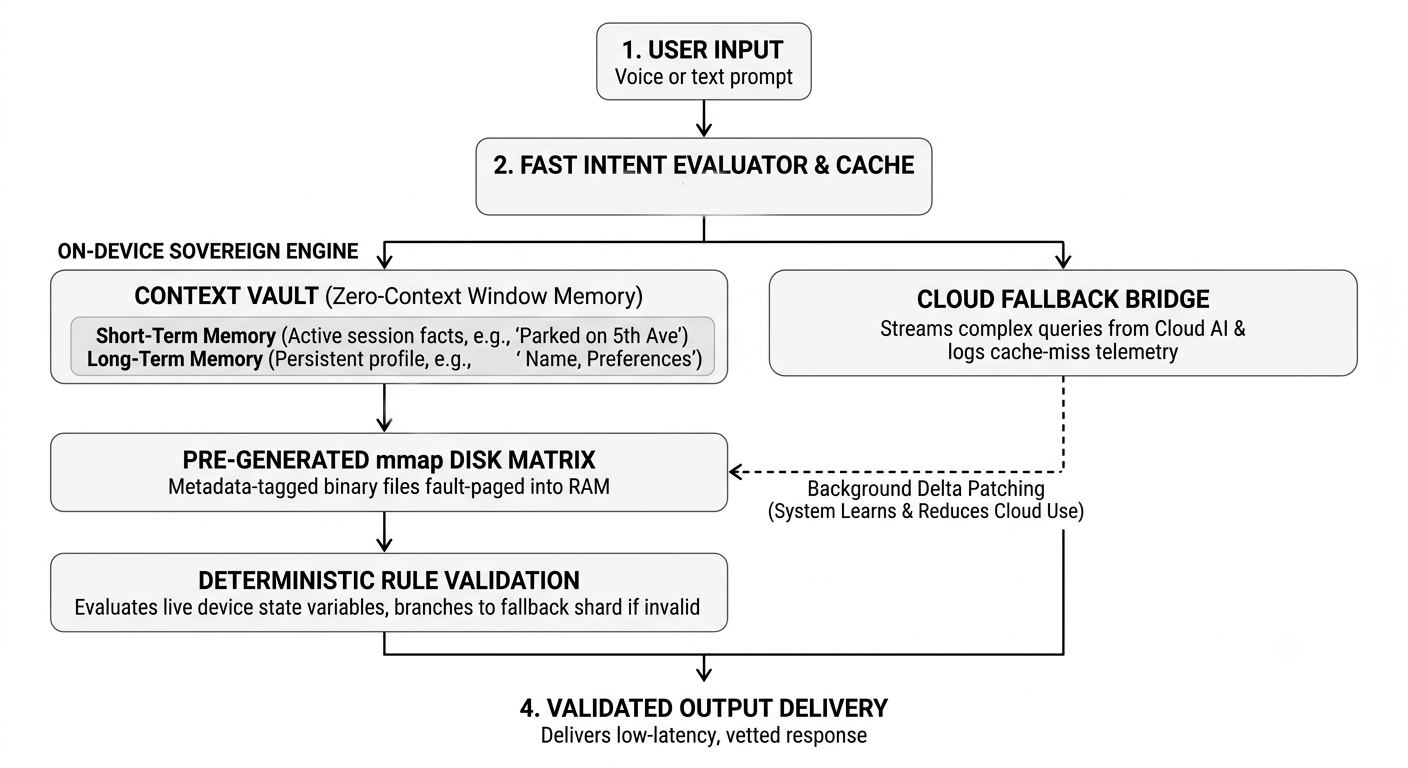
Instead of bloating RAM, we compile vast knowledge repositories into high-density storage-backed binary files. Utilizing POSIX-compliant mmap C functions, the operating system kernel maps binary files directly into virtual memory, fault-paging only the precise byte ranges required at that exact millisecond. Active RAM stays flat while unlocking massive model knowledge depth.
To deliver instant responsiveness, our zero-latency pre-filter categorizes user intent the moment a query arrives. By the time the small LLM executes, it already points directly to the target byte range within the storage-backed repository, bypassing traditional token-generation loading delays.
Our externalized, deterministic state machine—the Context Vault—persists active conversational variables using atomic file system operations. This allows a small edge model to maintain long-term, complex context across sessions with zero memory bloat or computational decay.
Attaches seamlessly to edge LLMs (from 1B/2B up to 26B+) to supercharge context retention, knowledge depth, and reflex speeds.
Maintains active context and persists user facts across sessions without compounding token cost or memory degradation.
Extends model intelligence using POSIX mmap binary repositories on disk—fault-paging deep domain facts instantly into virtual memory.
Zero-latency reflex pre-filtering intercepts intent and resolves requests instantly before heavy GPU/CPU token generation is needed.
Executes locally on edge hardware with zero-latency reflex speeds while maintaining seamless fallback to cloud compute for heavy out-of-domain queries.
Patent Pending: Provisional Patent Application US 64/105,371 — Pre-Generated Conversation Matrix with Caching (PCM). Our proprietary blend of structured index matrices, localized semantic classification gateways, and POSIX virtual memory mapping to storage-backed binary files is fully protected, positioning MMAP Labs as a core infrastructure layer for the next generation of embedded AI.
Fully offline, air-gapped threat detection and tactical edge intelligence without reliance on vulnerable cloud connections or heavy power draw.
Run complex conversational assistants on smartwatches, AR glasses, and embedded electronics without thermal throttling or draining battery life.
Zero-latency interactive NPC dialogue engines that execute instantaneously, keeping precious GPU cycles free for visual rendering.
Intercept and resolve repetitive queries at the local server level before they hit expensive downstream GPU server banks, drastically lowering cloud bills.
Co-Creator
Rob is a senior network architect, cybersecurity engineer, and granted patent holder (US12494845B2) with deep expertise in threat detection, embedded security, and zero-trust infrastructure. Backed by decades of experience engineering carrier-grade ISP core networks achieving 99.999% core uptime, Rob has spent his career building resilient, mission-critical systems designed to operate reliably under extreme conditions.
Working closely with cybersecurity pioneer John McAfee at MGT Capital Investments, Rob led the ground-up development of two flagship security platforms: Sentinel, an advanced series of honeypots deployed locally within an intranet to detect hackers and unauthorized probing, and E-Tagged, a specialized platform engineered to detect and track wireless devices as well as mitigate airborne wireless attacks. Under McAfee’s direct mentorship, Rob architected these systems for maximum process confinement—implementing stringent access controls, modOWASP web filtering, chroot jails, and custom AppArmor profiles for process-level isolation.

Co-Creator
Adrian is a globally recognized operating systems kernel architect, open-source maintainer, and high-performance systems engineer with over 30 years of experience pushing hardware and networking capabilities to their theoretical limits. A prominent committer and lead wireless architect (net80211) within the FreeBSD project, Adrian is celebrated across the technology industry for his foundational work on kernel page handling, Wi-Fi device drivers, and ultra-low-latency operating system stacks.
Throughout his career, Adrian has solved critical infrastructure bottlenecks at the highest levels of tech. At Meta, he engineered core Board Support Packages (BSPs), Wi-Fi drivers, and platform power, thermal, and memory efficiency architectures for Meta’s flagship AR/VR wearables, including Project Orion AR glasses and Meta Ray-Ban smart glasses. Prior to Meta, Adrian served as a core maintainer of the Squid Web Proxy and a key infrastructure engineer on Netflix's Open Connect CDN team, engineering zero-copy kernel memory pipelines capable of saturating 10Gbps+ fiber links with zero CPU bloat.
Interested in licensing our technology, integration partnerships, or investment opportunities? Reach out below.